

Away from the glitz of the professional game, a weekend of ‘farm polo’ on a sleepy estancia offers a glimpse of Argentina’s national passion.
Bella Pollen is an acclaimed British author and journalist whose writing has appeared in leading publications including the Financial Times, The Times and Vogue. The author of several novels and the memoir Meet Me in the In-Between, her work spans travel, culture and personal storytelling.
Here, she travelled with Plan South America into the heart of the Argentine Pampas for the Financial Times, experiencing the landscapes, estancias and gaucho traditions of rural Argentina.
Words by Bella Pollen and photos by Michael Turek.
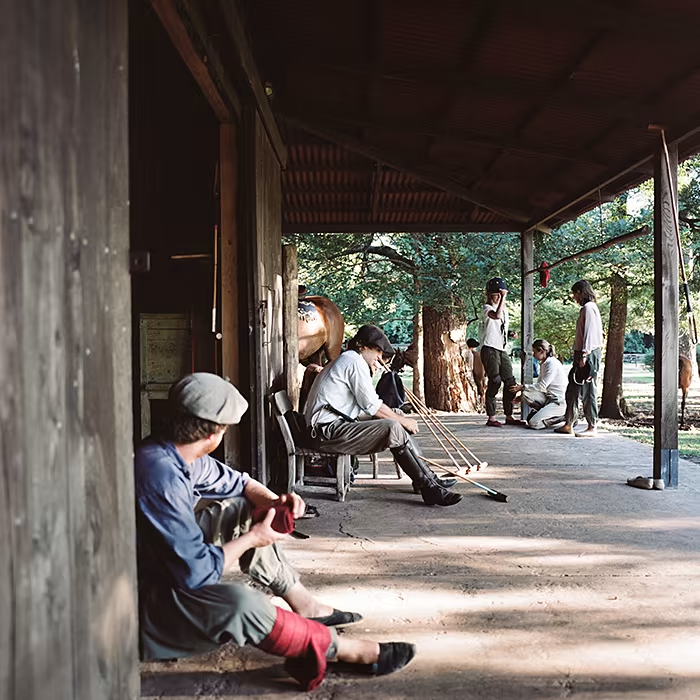
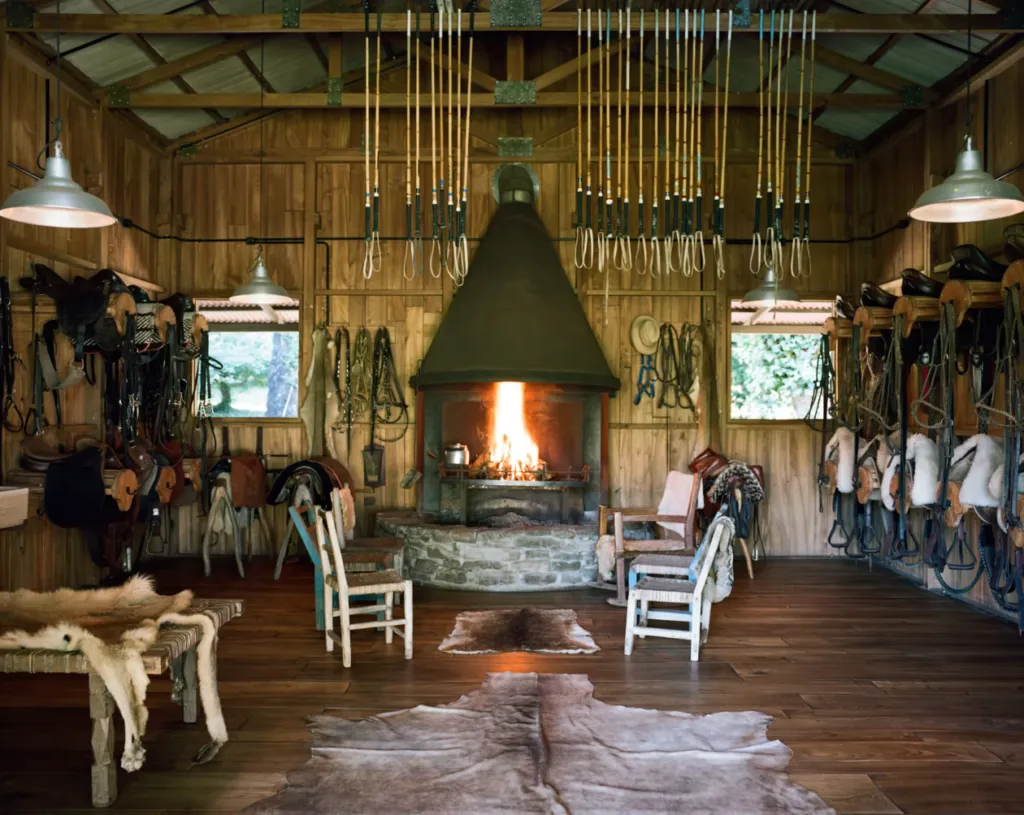
“In a cabin on the edge of a wood, dust spins in the sunlight over a pile of sheepskins and saddle blankets. Bridles, seasoned by sweat, are pinned to the walls. A line of pale, thin whips hang from the ceiling beams like some postmodern art installation. Around a stone-built fire, chairs have been assembled, for no better purpose, perhaps, than to sit quietly and absorb the musty essence of horse.
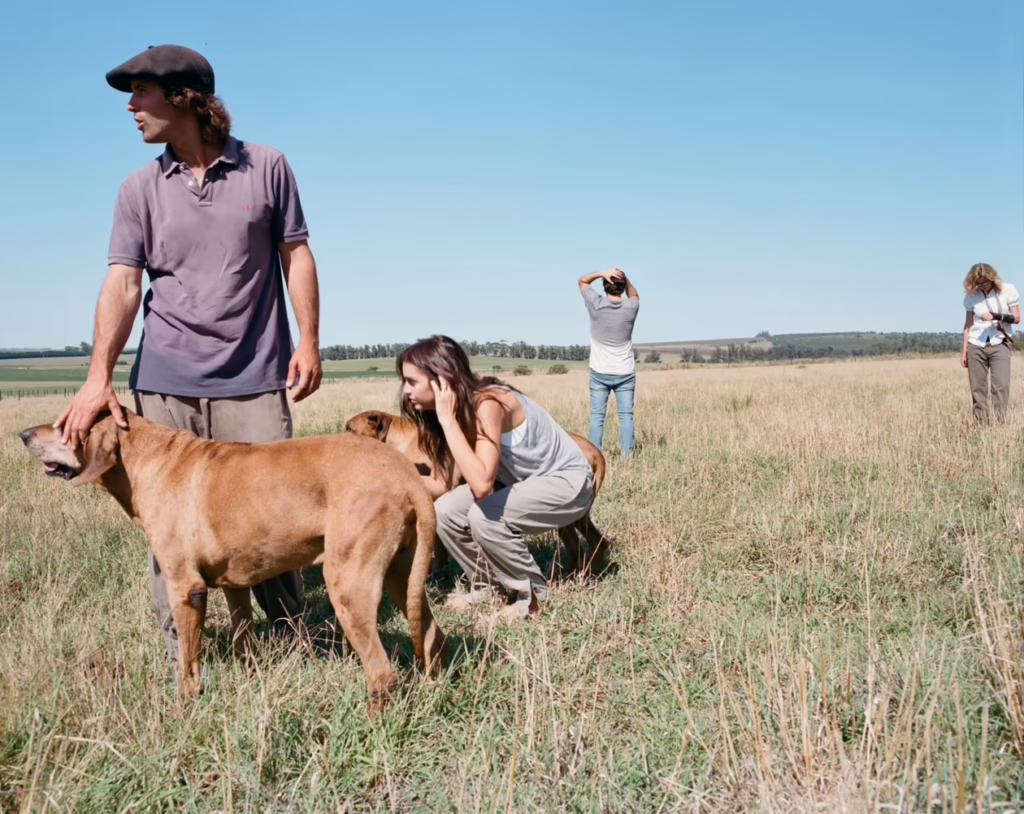
This most pleasing of spaces is the tack room of El Boqueron, a sleepy estancia deep in the Pampas of Argentina. The farm is home to 122 horses, most of which, owner Jakob Von Plessen confesses, are running wild. “See what I mean?” he points accusingly as a band of variegated tans and browns stream out of the distant trees, impudently flicking their tails. “I’m not sure why they’re here, or what to do with them,” he adds, moving to a wooden table outside, “but one thing’s for sure, the horses have taken over.”
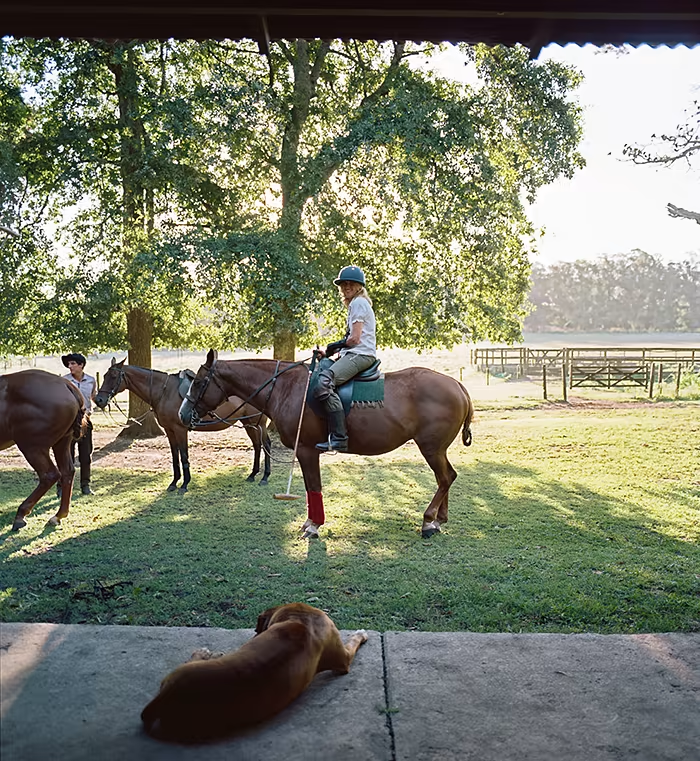
It’s late afternoon. The big summer skies over the Pampas are hazy. Up in the cypress trees, songthrush and mockingbird screech and chatter. The air is thick with the hum of bees and our stomachs full of red wine and grilled meat. Overcome by torpor, no one stirs. No one except for Mariano, the gaucho, moving in and out of the tack room fetching coloured bandages to wind around the legs of the polo ponies tied loosely nearby.
Polo, ah yes. The main reason I’ve come for a long weekend to this private estate-turned-hotel — for a lesson in the fast and furious game, and one for which I may have the wrong kind of handicap. Horses did not feature much in my steel and glass city upbringing. Those I did encounter were dour, blinkered creatures, clip-clopping around Central Park, harnessed to the tourist’s charade of New York’s bygone era. I never could summon much interest.
Back in England, though, my grandmother lived in the countryside and one summer we arrived to find a freckled white mare grazing in her field. Unexpectedly I fell in love. I would ride bareback over the bright green grass, my hands threaded through her tangled mane. My grandmother, more pragmatic, enrolled me in pony club. On the first day, the fat little Thelwell creature I was assigned bit me on the arm. I took a retaliatory nip out of its ear, and found myself expelled before lunch.
I’ve braved the saddle since, but though I find horses the embodiment of grace, mounting one makes me nervous. Then, there is polo itself. Men with Aston Martins and Oompa Loompa tans, slithering in and out of cologne ads. The archaic scent of aristocratic entitlement clings stubbornly to the sport of kings, but it seems churlish to come all this way and not be curious about Argentina’s passion for the horse, the game and the culture behind it.
Circa 600BC, some bright general somewhere in Persia dreamt up the game of polo to whip the king’s cavalry into shape. It must have been quite the spectator sport. One hundred fearsome warriors, rushing each other with sadistic howls before a half-time break of orange quarters. Over the centuries it spread via Tibet and Constantinople to India, where it was instantly appropriated by the English, who exported it to Argentina around 1870.
Today, the Argentinians are the undisputed gods of the game, having won the World Polo Championship more than any other nation. Mention this to the average Buenos Aires doctor or bus driver and he or she will shrug. Polo might be egalitarian, in that all classes participate in the businesses that prop it up, but if you grow up scraping the mould off your bread, chances are you will never compete professionally.
“Polo is not an endurance sport,” Jakob pours his mate from a battered kettle and takes the first pull of bitter tea from its silver pipe, “horses are ridden at full tilt and as soon as one tires, a player hops on to a fresh one — as often as eight or nine times a game.”
A serious contender needs a minimum of 18 top-class polo ponies, all of which come with the requirement of land to graze, grooms to train and the financial oomph to ship around the international circuit. “Forget the English upper classes.” He passes his mate gourd on, “from the Russians to the Saudis, there’s a whole new breed of snob in the game…”
Not so with farm polo, which we’re gearing up to play — a leftover from when the Pampas was primarily cattle country and estancias such as El Boqueron were vast working ranches. Farm polo is historically played at weekends, friend against neighbour, boy against girl. Those who’ve rolled in for tonight’s game are not wearing team shirts or questionably tight trousers, but bombachas and boinas, the traditional baggy pants and flat caps of the gaucho. Watching them around horses, I can see why Argentinians excel at this game. It’s not just that they’re naturally competitive and raised on a diet of steak and sun, the sport of polo also slotted into a culture of exceptional riding that began when the Spanish conquistadors brought the horse to Latin America.
But, earlier this morning, gazing across the Pampas from Boqueron’s wide shady veranda, I saw not one cow. Only a tractor idling, waiting on the harvest. Beef has been replaced by the soya bean and the allure of a government subsidy. One by one, cattlemen have converted their century-old ranches, displacing gaucho culture and the artisan businesses that sustained it.
“The story of Boqueron is the story of the decline of the once-great estate,” said Jakob’s mother, Christl, bringing out breakfast on a big wooden tray. Originally 5,000 hectares, it was owned by the Anchorena family who, in the 1940s, watched as nearby Mar del Plata became the Biarritz of South America. Grand architects were brought in to build casinos and hotels. Not to be outdone, the Anchorenas commissioned a private golf course from Scotsman Alister MacKenzie, designer of the Augusta Club, one of the most famous courses in the world. But Argentine inheritance laws do not favour primogeniture and the Anchorenas had many children. Christl bought Boqueron, diminished to 120 hectares, from one of the 90-year-old sons who had been selling off his share piecemeal for years. “Sad really,” she said, “he was so low on money he’d even ploughed over Mackenzie’s golf course to plant potatoes.”
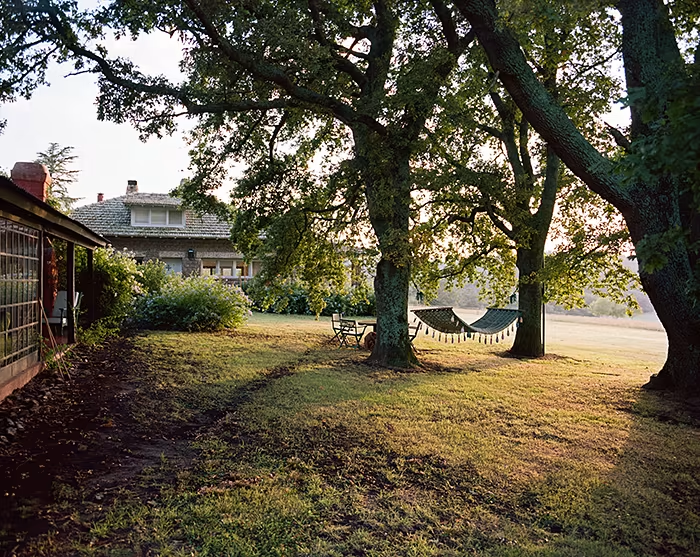
Built as the club house for the golf course, Boqueron is a 1920 prefabricated colonial tea house, ringed by lantana bushes and waving agapanthus. We walked through the large cool rooms, Christl pointing out the original features of wide curved doors and decorative ironwork. An interior designer, she restored everything else, painting walls in earthy greens and umbers, commissioning Ricardo Paz furniture made from old rail slats and strewing them with her magpie collection of bold textiles. “This is from the dry forests of the north,” she said, “these are coming from Bolivia or Peru, I can’t remember . . . ”
Her warmth and flair for making paying guests feel like old family friends has much to do with the casual charm of this place. Meals taken outside are usually asado, Argentina’s hymn to meat, grilled on a traditional parilla. The previous day we had eaten crisp butterflied lamb set up in an orchard of mandarin and grapefruit trees. Today’s lunch was melting blood sausage and steak under a pergola of vines.
The Pampas are full of immaculate country hotels where guests gather daily at 4pm to watch the resident gaucho and his horse perform a routine, accompanied by elevator muzak. It’s entertaining stuff but a little short on romance. The more untamed Boqueron feels closer to how life must have once been. Jakob, who presents as a somewhat Byronesque gaucho himself, is careful how many people he brings here. “What is this place now?” he says, pulling on his polo boots. “You can’t call it a farm any more, as it’s not sustainable. There are no stables for the horses, no fences for cows. Fifteen years ago there was a huge demand for Argentinian polo ponies. Every impoverished estancia owner tried breeding, then artificial insemination was legalised and the industry changed for good.”
A shot of sperm costs between $1,000 and $10,000. An embryo up to 10 times that. Growing polo ponies in a Petri dish is a cut-throat business. Small estates couldn’t compete so, like the Von Plessens, they turned to tourism. Jakob runs horse safaris in Patagonia where the riding is slow and precipitous. The flatlands of Boqueron are about speed. A family might take over the property to learn polo or simply flop after a wider tour of the country. There is plenty to do that’s non-horsey. Swim, shoot pool. There’s golf nearby and Mar del Plata nightlife should one want it, though no one ever does. The feeling of home is too seductive, the atmosphere too languid, the food too vivid. “But does it pay?” I ask. Jakob hands me a scuffed pair of knee-pads and grins. “Not really.”
It’s 6pm by the time we’re armoured up and ready for battle. As we file on to the polo field, the ears of the horses prick with excitement. It was the British who mixed criollo with thoroughbreds to create a horse that was strong and fast enough to swivel on a sixpence. Ponies and players alike need courage. After all, instead of a ball, the Persians bashed around skulls, which are reasonably light, while Buzkashi, the Turkish version of the game, favoured a nice soft goat. A modern polo ball is made of high–impact plastic. Take that to the face and it does serious damage.
Boqueron’s polo pitch is a mown paddock, the size of three football fields. I begin cantering around in tentative loops, practising turning in ever tighter circles. The others zigzag across my path shouting instructions. Let the mallet be the pendulum! Hover over the saddle! Forget chukkas and penalties, broadly speaking here’s the aim of the game. Spot the ball, extricate it from beneath the clattering hooves and whack it into the net, all at speed, all without breaking your neck. Easy . . . I take a crack at something that turns out to be a fox turd. No matter, I’m already hooked. This sport is wildly exhilarating. I dismount for a breather and rest my forehead against the horse’s damp, beating flank.
The sun burns low by the time the players join Christl, Jakob’s girlfriend Saira and their daughter Malika at the tea table. The horses hang close, bumping their riders’ backs as we sit eating Sachertorte. Malika, still in nappies, displays a casual indifference to the pony muzzling cake off her plate. Here’s the real reason for Argentinian supremacy. If in England, a horse is a privilege, here it’s part of everyday life. Malika will be given a mini mallet by the time she’s five. By eight, she’ll be playing in games like this one. If, that is, the tradition lives on.”
CONTACT US
Private travel across Latin America and Antarctica, designed by specialists.

Conde Nast Traveler Specialists every year since 2017