
Myths, mysteries and extreme isolation make the island a compelling destination.
Stanley Stewart is an acclaimed British travel writer and journalist whose work has appeared in leading publications including Condé Nast Traveller, The Sunday Times and The Telegraph. Known for his evocative writing on remote landscapes, cultures and journeys, he has travelled extensively across the world in pursuit of extraordinary stories. Here, he journeyed to Easter Island with the Financial Times as a guest of Plan South America and Explora Rapa Nui.
Words by Stanley Stewart
“Mysteries pile up in this remote place, a teetering pyramid of riddles and puzzles, a series of Holmesian three-pipe problems. The best minds of Polynesian history and anthropology have spent decades trying to decipher its complex past. But much of what has happened here seems beyond comprehension.
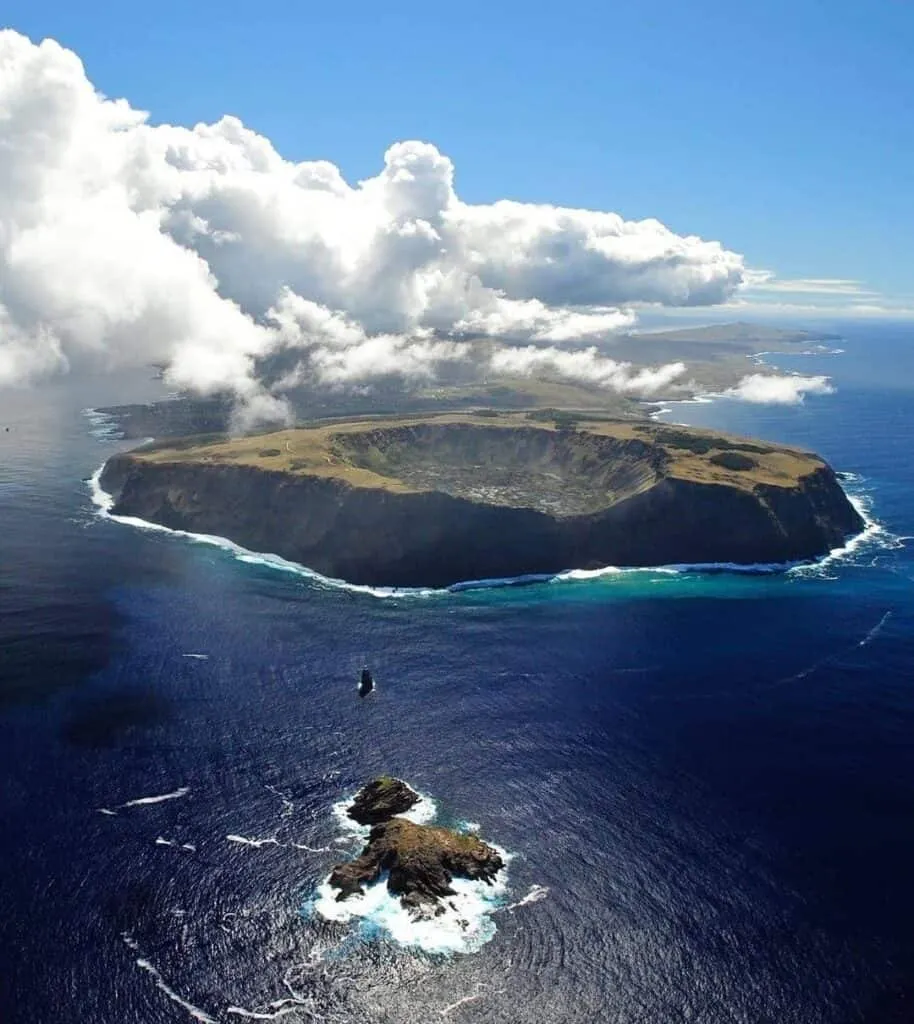
On the flight from Santiago, I began to appreciate Easter Island’s isolation. We flew for five hours across the Pacific without seeing a speck of land. Easter Island is one of the remotest inhabited places on Earth. South America is 3,512km away. The nearest inhabited island is 2,075km away. And that island is Pitcairn, a place so remote that the Bounty mutineers went there to disappear. One of the old recorded names for Easter Island — Te Pito o te Henua — can be translated as “the end of the world”.
The first mystery is how the islanders arrived, and why. That the Rapa Nui — the native name for the islanders — are Polynesians is now widely accepted. Most historians agree that they probably came from the island of Mangareva, over 2,600km away, sometime around 1200AD. They would have travelled in outrigger canoes. Lacking sextants, astrolabes or chronometers, Polynesian navigation has astonished every European sailor since Captain Cook with its ability to find tiny islands in oceanic haystacks. How the Rapa Nui came upon Easter Island, when the last 1,500km or so offered no landfalls whatsoever, is the mother of all mysteries.
As tropical islands go, Easter Island falls a little short of the ideal of a South Seas paradise. Gauguin would not have lingered. There are few swaying palms, only one sand beach, no coral reefs, no luxuriant jungles, no delightful waterfalls and no floral garlands to be draped around your neck as you step ashore.
But I didn’t mind. In a barren windswept way, the island is stunningly beautiful beneath its vast Pacific skies. It reminded me curiously of the west of Ireland, Connemara perhaps — a rocky shore, a green landscape a little short on trees, lonely roads, stone walls, loose horses galloping away across a moorland of rock and grass tussocks. When I asked an islander about the horses, he said they were wild. Though not as wild, he added, as their owners. It could have been a Connemara man’s joke.
–
I hired a motorbike in Hanga Roa, the island’s only town, and set off on the road along the south coast, heading for the quarry where the famous statues, or moai, were carved. The air tasted of salt, and along the shoreline, waves threw up tall aprons of spray. Far out, the unblemished line of the horizon divided two shades of deep blue.
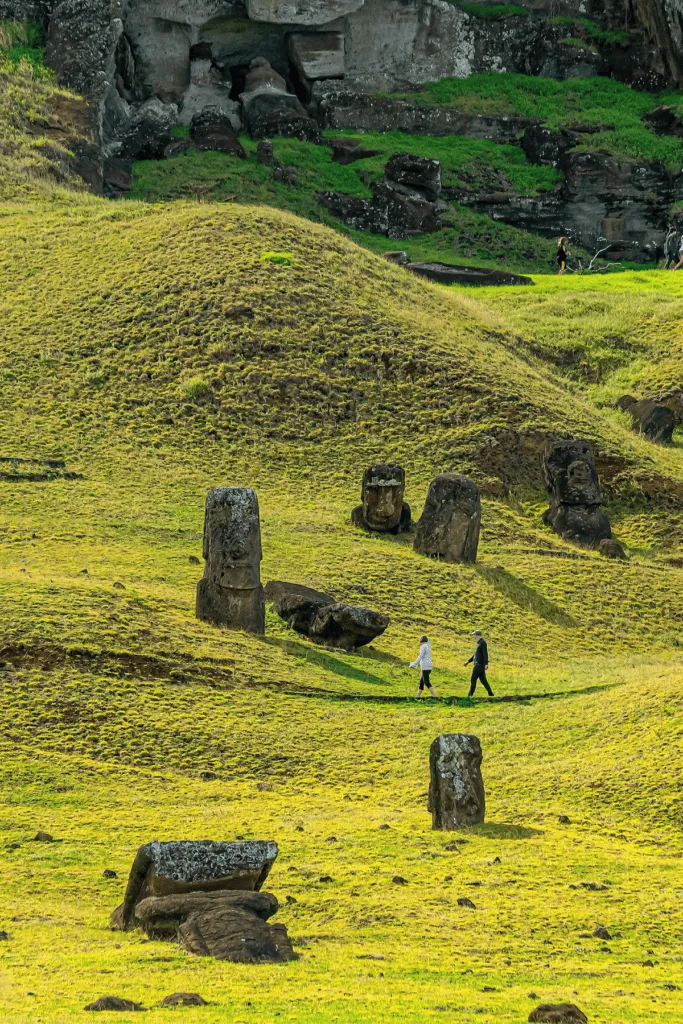
One of two volcanic craters on the islands, the slopes of Rano Raraku were the island workshop. I browsed among dozens of figures in various states of production, some half carved, others still encased in the surrounding rock, still others standing and apparently ready to start the long journey to their allotted position on the island.
All the statues are more or less the same — a legless long-eared male torso and head. They vary only in size. Most are between 15 and 20 feet in height. Others, elsewhere, are more than 40 feet tall and weigh in excess of 70 tonnes. Here in the quarry, in the disarray of this ghostly studio, it was as if the carvers had suddenly downed tools one afternoon and walked off the job never to return.
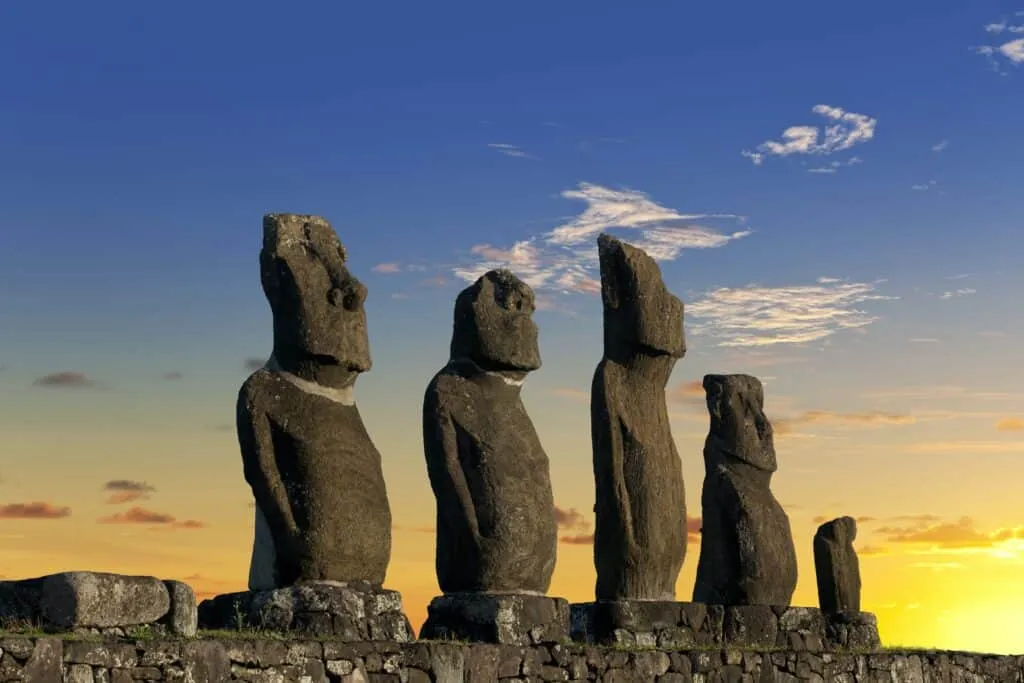
I sat on the rim of the crater and looked out towards Ahu Tongariki, one of the island’s most iconic sites, where 15 completed statues stand almost shoulder to shoulder on their raised platform. The moai were protective deified ancestors. Everywhere they have their backs to the sea, looking inland across their island, keeping an eye on their descendants. With their stoic posture, jutting chins, prominent noses and disapproving mouths, they evoke the resilience and the determination of an island society. The heads are not mere representation; they are stylised and expressive. They are works of art, albeit in a creative tradition that is frozen at the point of inception.
But like everything here, they prompt a torrent of questions. Why did the Rapa Nui build so many heads when other Polynesians were content with a few sacred idols at a handful of sites. The islanders seemed to have been consumed by a kind of religious mania, some strange form of spiritual OCD, as they erected almost 1,000 statues on this small island. Another 400 or so unfinished statues awaited transportation in the quarry at Rano Raraku. Excavation may well reveal many more.
The great heads came to be known as the statues that walked. We still struggle to understand how the islanders moved them from the quarry to various positions, sometimes miles away, around the island. When the statues at Ahu Tongariki were reinstalled on their platform in the early 1990s, the Japanese consortium who volunteered for the job had to fly in a giant crane to deal with blocks of carved stone that weighed up to 88 tonnes. The Rapa Nui did not even have draft animals, and they had not invented the wheel.
Whatever the reasons, whatever the mechanics, the scale of this religious mania indicates an island of enormous wealth, able to lavish such resources on the construction and transportation of these colossal heads. Yet the early Europeans who began to arrive on the island in the 18th century describe an impoverished society. At some point — yet another mystery — Easter Island society had collapsed. Visitors found a shrunken population, a denuded island, a state of poverty. There were even rumours of cannibalism. How did it all go so wrong for a society once capable of one of the world’s greatest engineering feats prior to the modern age?
–
For some time, the collapse of Easter Island was assumed to be connected to the statues, and in particular how they were moved. The idea is the islanders had committed ecocide; they chopped down trees recklessly to build road beds on which they could move more and more of their gods on rollers fashioned from tree trunks. Eventually the island was left treeless and barren. Easter Island became the poster habitat for the overuse of natural resources and subsequent environmental degradation.
But careless exploitation of their habitat seems to be only part of the story. Archaeologists and historians are now adding another layer to this complex history, something that prompted a more sudden collapse of island society.

I asked staff in my hotel if they could put me in touch with any old people, who could tell me about an earlier era on the island, the days of their youth. The next day Antonia Rapahango appeared in the lobby. An octogenarian, she sat very erect in a chair by an open window, her beautiful hands folded in her lap. Over her shoulder, through the window, I could see the empty Pacific beneath a cloudless sky. Antonia began to speak in soft, almost genteel tones, dramatically at odds with her account of the island’s past.
Antonia is the daughter of an Easter Island mother and the Englishman who ran the sheep station on the island for many years. She confesses to being ashamed of her English lineage. During her father’s time, she explains, the islanders were removed from their lands — a kind of South Pacific Clearances — and confined to the village so that 70,000 sheep could have free grazing. She described the years of the sheep station — and it lasted through the first half of the 20th century — as a kind of enslavement, and by implication her own father as a slave master.
It was a grim episode but only one of many, Antonia said. There were the slave raiders from Peru in the 1860s, when up to 1,500 islanders were forcibly removed to work on continental plantations. There was the annexation by Chile in 1888. The Deed of Cession, presented to the island “king”, a man chosen by the missionaries, was in Spanish; its translation in Rapa Nui was imperfect and misleading, a deception that still rankles with islanders today.

“Outsiders,” Antonia said quietly, “have had a disastrous impact here on this island. But the worst impact was at the beginning and it was inadvertent.”
When the first Europeans arrived on Easter Island — a Dutch vessel in 1722 — the ship’s log described standing heads. Yet when Cook arrived 52 years later, some of the heads had been toppled. Subsequent visitors reported fewer and fewer standing heads. The last report of an upright moai was from a French naval officer in 1838.
Archaeologists confirm many of the statues were deliberately toppled in a manner designed to break their necks. It seemed the Rapa Nui, sometime in the 18th century, had turned on the ancestral deities that they had spent generations creating — an extraordinary act of religious rebellion. And it appears it may have been the arrival of Europeans that prompted this iconoclasm.
“For the Rapa Nui, everything changed in [a] few fateful days,” suggest the archaeologists Terry Hunt and Carl Lipo, referring to the arrival of that first Dutch ship. Though the European sailors were only ashore for three days, they would have undoubtedly unleashed on to the island a wide range of pathogens, many inconsequential to the Europeans themselves, that would devastate the Rapa Nui who had no immunity against them. Among native American populations, where up to 90 per cent of some tribes died, this phenomenon of introduced germs became known as the American Holocaust. As waves of fatal illnesses swept Easter Island, reinforced by each visiting ship, the rapid decline of the population carried away the economic, cultural and social fabric of the island. By the late 1800s there were barely a hundred native people left on the island. It is no wonder that the survivors felt the gods had abandoned them.
–
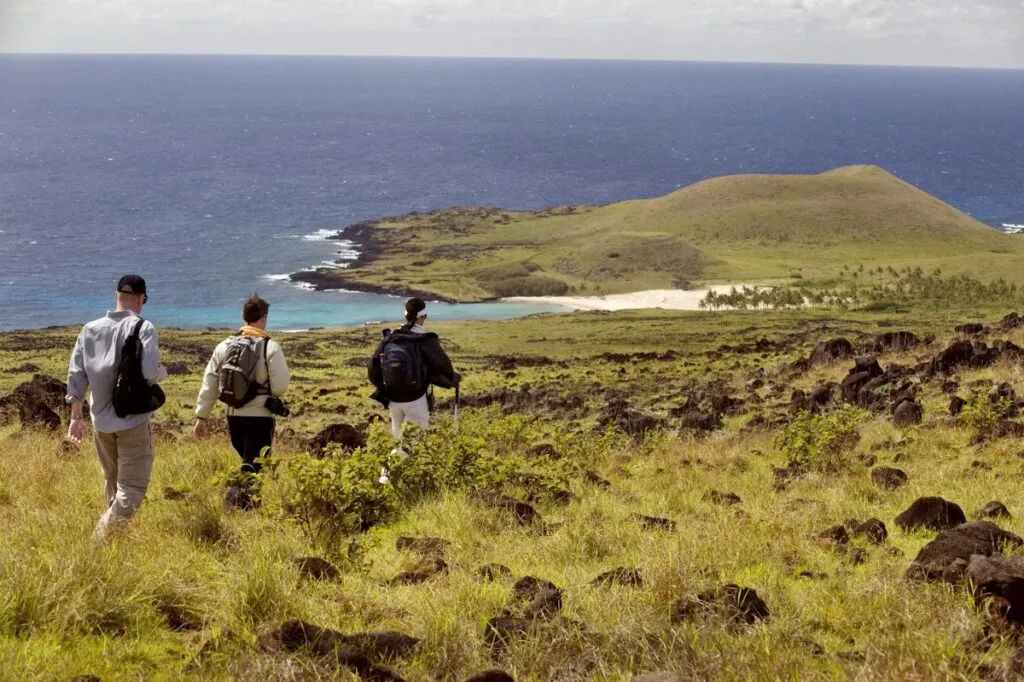
On my last afternoon on Easter Island, I went to Ahu Te Peu, an isolated site on the north-west coast that rarely attracts visitors. It is reached on foot, almost half an hour’s walk from the road. The gate to the site was locked but I climbed a wall to follow the track to the sea and the ruins of the old settlement.
It was early evening, and the shadows were lengthening across a wide moorland where yellow tussocks of grass sprouted among black volcanic rock. The ruins of Ahu Te Peu are blessed with a glorious setting. The rubble of the ancient settlement is strewn across a wide slope above sea cliffs beneath which the Pacific surges and roars. Far out patches of sun sailed on an empty ocean. Ahu Te Peu had been one of the major settlements on the island. There were no standing heads here — it is a bit remote for that massive Japanese crane — though if you rummage among the ruins you will find them scattered in pieces. There is a fine wall that has prompted some historians — among them Thor Heyerdahl — to suggest a link, erroneously, to the immaculate mortar-less masonry of the Inca.
In the long grass I found the elliptical foundations of “boathouses”, known as hare paenga, yet another of Easter Island’s mysteries. Found throughout the island, often close to the moai, historians believe they may have been used as dormitories during rituals and ceremonies. Perhaps the boathouses were some evocation of the epic voyage that had brought their ancestors to the island, the time of their lost beginnings.
Today Ahu Te Peu is a lonely place. The sun was setting. The sound of the surf booming at the base of the cliffs rose into the evening. Birds wheeled and shrieked like lost children.
Among these old stones, on the edge of those cliffs, I felt the isolation and vulnerability of Easter Island. The Rapa Nui were alone here for their first half a millennium or more. There were no invaders to galvanise them, no alliances to support them, no neighbours to offer useful comparisons. Their isolation meant they did not even have the immunities that would allow them to survive the onslaught of European diseases. When those white sails appeared on the horizons, they signalled not the arrival of new gods, but the end of this curious society and the abandonment of the great heads that may have represented whatever happiness the Rapa Nui had found here.
There is a final irony. With an understandable anxiety about the influence of outsiders, some Rapa Nui have concerns about tourism. But as the magnificent heads were raised from the archaeological rubble and replaced on their plinths, it is undeniable that tourism has transformed this island, bringing levels of prosperity that would have been unthinkable when Antonia was a child. In the end, the old gods have been saved, those protective ancestors, once spurned and broken, now gazing across the island again with their inscrutable expressions.”
CONTACT US
Private travel to Latin America and Antarctica, designed by specialists.

Conde Nast Traveler Specialists every year since 2017